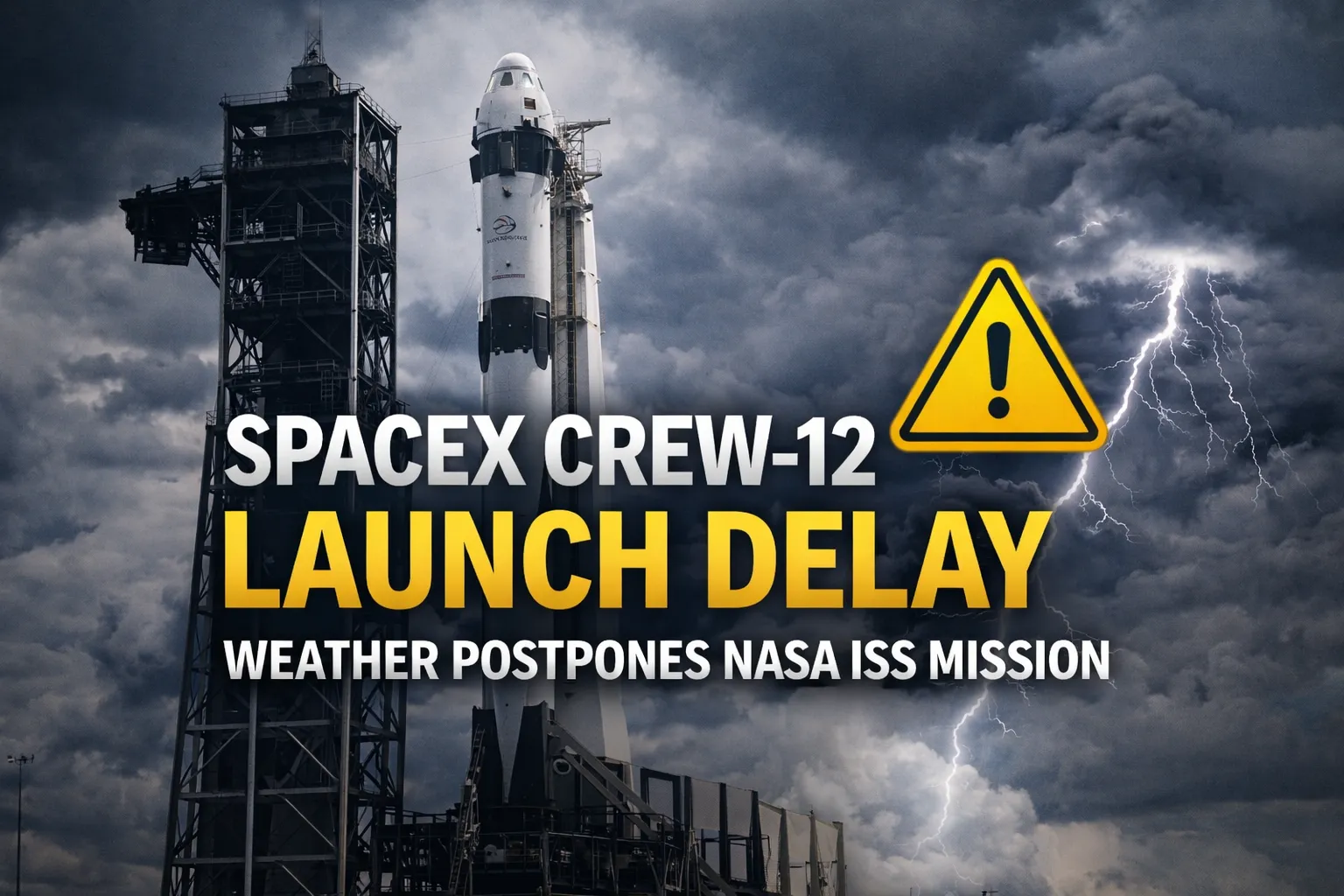
The SpaceX Crew-12 launch delay has drawn widespread attention after NASA and SpaceX postponed the mission due to unfavorable weather conditions. The highly anticipated launch, carrying four astronauts to the International Space Station (ISS), was delayed multiple times before receiving final clearance.
The postponement highlights how sensitive human spaceflight missions are to weather risks — even when the spacecraft and rocket are fully ready.
Why Was the SpaceX Crew-12 Launch Delayed?
NASA confirmed that the delay was caused primarily by high winds and unsafe weather patterns along the Falcon 9 rocket’s ascent corridor.
Launch criteria require safe conditions not only at the launch pad but also:
- Along the rocket’s flight path
- In potential emergency abort zones
- In ocean recovery areas
High-altitude winds can pose risks during liftoff or in the unlikely event of an emergency abort, prompting mission managers to delay the launch in the interest of crew safety.
Crew-12 Mission Overview
The Crew-12 mission is part of NASA’s Commercial Crew Program, operated in partnership with SpaceX. The astronauts aboard the Dragon capsule are scheduled for a long-duration stay aboard the ISS, where they will conduct scientific experiments, maintenance, and technology demonstrations.
Mission Highlights:
- Launch Vehicle: Falcon 9 rocket
- Spacecraft: Crew Dragon capsule
- Destination: International Space Station
- Mission Type: Long-duration expedition
Impact of the Launch Delay
While launch delays can be disappointing for space enthusiasts, they are common in human spaceflight. Safety remains the top priority for NASA and SpaceX.
The delay:
- Ensures optimal launch and docking conditions
- Protects crew safety
- Prevents unnecessary mission risk
Weather-related postponements are often resolved within days once conditions improve.
What Happens Next?
Once favorable weather conditions return, NASA and SpaceX will proceed with the next available launch window. After liftoff, the Crew Dragon spacecraft will:
- Reach low-Earth orbit
- Perform orbital maneuvers
- Dock autonomously with the ISS
Docking typically occurs within 24 hours after launch.
Why Weather Is Critical in Space Launches
Many people wonder why launches are delayed even when skies look clear. The reason is that launch weather monitoring includes:
- Upper-level wind speeds
- Lightning risk
- Cloud thickness
- Downrange sea conditions
Even minor weather violations can trigger an automatic scrub.
Final Thoughts
The SpaceX Crew-12 launch delay demonstrates the rigorous safety standards governing modern space missions. While weather may temporarily postpone liftoff, it ensures astronauts travel under the safest possible conditions.
As NASA and SpaceX continue advancing commercial spaceflight, flexibility and safety remain central to mission planning.